By Jocelyn Lee, Editorial/Marketing Intern “May the God who gives endurance and encouragement give you the same attitude of mind toward each other that Christ Jesus had, so that with one mind and one voice you may glorify the God and Father of our Lord Jesus Christ” (Romans 15:5–6). Culture of Peace is a book that acknowledges that … Continue reading The Gift of Conflict: 3 Insights into How Conflict Is Valuable from Culture of Peace
Review: The Bible and Archaeology by Richelle
10 Ways to Avoid Stress and Renew Mental Health from Take Care of Yourself
By Tirzah Frank, Assistant Editor Dr. Pablo Martinez’s Take Care of Yourself: Survive and Thrive in Christian Ministry is a petite book packed with comprehensive self-care advice. It’s geared specifically toward people in ministry, but much of Martinez’s advice is applicable to everyone. Here are ten self-care suggestions I gleaned from Take Care of Yourself: … Continue reading 10 Ways to Avoid Stress and Renew Mental Health from Take Care of Yourself
10 Best Prayer Quotes by Charles Spurgeon
“The prayers that come leaping out of the soul—the gust of strong emotion, fervent desire, lively faith—these are the truly spiritual; and no prayers but spiritual prayers will God accept.” Charles Spurgeon dedicated much time and effort to dissecting the best ways to pray and what to ask or say in prayers in many of … Continue reading 10 Best Prayer Quotes by Charles Spurgeon
What Vocab is Provided? An Explanation and Sample Text
Check out this post written by Will Ross and Greg Lanier about the vocab in the LXX Reader’s Edition, as well as a sample text from Exodus!
To preorder the Septuaginta: A Reader’s Edition, click this link.

Probably the most obvious question to ask about a reader’s edition is “What vocabulary do you provide?” After all, that is the basic function of this kind of book—to supply the reader with guidance on the form and meaning of difficult vocabulary.
So obviously that’s what we did.
But how did we define “difficult vocabulary” for Septuaginta? It was actually a pretty tricky issue to address. Let me explain.
View original post 799 more words
Review: BHS Reader’s Edition

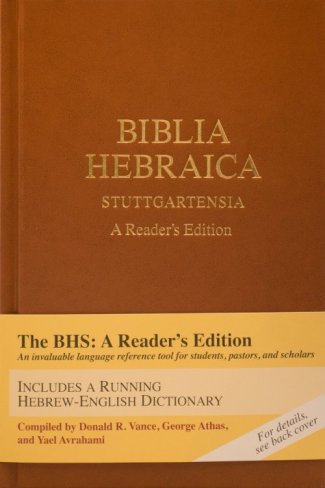
You spend time learning massive amounts of paradigms ad nauseum, learned the definitions of words that look the same (at least you did for the quiz), and you’ve even learned some syntax to boot. But now you’ve completed the course, and in order to keep going on, you have to read the thing. Where does one start reading Hebrew?
Some students are motivated enough to pick up their BHS and their lexicon, but not everyone is so motivated. After passing Crucible I and II, you take your summer vacation “break,” but you almost never look back. How do you begin reading Hebrew again? The poetry and the prophets can require hours of searching through a lexicon for the appropriate words for only a mere few verses. I have a good feel for the weak roots because of my professor, Peter Gentry, but hollow roots are still a pain.
The Biblia…
View original post 754 more words
Review: Dictionary of Daily Life in Biblical and Post-Biblical Antiquity
“From the far-reaching scope of the articles to the comprehensive exploration therein, DDL is a useful and affordable resource that merits immediate attention from any serious student of the Bible.”
Read John Kight’s full review of the one volume edition of the Dictionary of Daily Life in Biblical & Post-Biblical Antiquity here:

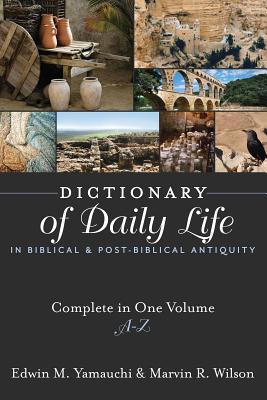 The landscape of specialized biblical and theological dictionaries seems to experience continual growth year-by-year. These dictionaries generally boast more focused and detailed attention on content and tend to provide a more unique product as an end goal. The level of usefulness of these types of dictionaries can vary greatly depending on the academic or personal interest of the reader, as well as the specializations of the contributing roster. Still, because of the distinctive qualities of such works the price-point is generally out of reach for most consumers. The intersection of such usefulness and availability is tellingly rare in this distinctive reference genre, and thus when it is clearly observed attention should be widely merited.
Originally published as four paperback volumes, TheDictionary of Daily Life in Biblical and Post-Biblical Antiquity edited by Edwin M. Yamauchi and Marvin R. Wilson has now arrived as a single-volume resource lodged in a beautiful…
View original post 583 more words
The Missionary Experience: A Path of Faith in the Midst of Paradox
“In our witnessing and serving, the path of God may cut through mystery and paradox.”
Check out Michele Morin’s lovely review of A Leopard Tamed!

Starting in the book of Acts, the history of missions is characterized by controversy. It may have begun when Paul and company set out with freshly-minted instructions from the Jerusalem Council, defining the parameters of the message they were sharing. It was certainly evident when the citizens of Lystra decided to fold Paul and Barnabas into their eclectic assortment of deities–and then to take up stones against them. And remember the story of New Testament heroes of the faith clashing over personnel issues and going their separate ways for a season? Throughout history, according to His own counsel and sovereign wisdom, God has chosen to put the transmission of the Gospel into the hands of His fallen and often short-sighted children, and the effects of that have made for some fascinating reading.
A Train-Wreck of Two Cultures Colliding
Over fifty years ago, Eleanor Vandevort came home from South Sudan…
View original post 1,565 more words
Review: Herman Bavinck on Preaching and Preachers
To learn more about Herman Bavinck on Preaching & Preachers, visit our website.

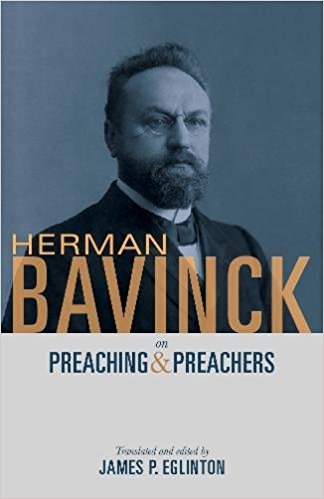 I allow myself few reviews during the school semester, but I wanted to take a little pause between papers to highlight a new Herman Bavinck book. James P. Eglinton, lecturer in Reformed Theology at New College in Edinburgh and author of the groundbreaking study Trinity and Organism, has just edited and translated a little volume Herman Bavinck on Preaching & Preachers. In it he collects a couple of lectures on the nature of Eloquence, the place of the sermon, reflections on language and preaching in America, as well as a translation of the only published sermon of Bavinck’s we have. (Apparently Bavinck mostly preached from sparse notes, or without any.) Eglinton also includes a helpful short biography of Bavinck as a preacher, introducing the work as a whole.
We ought to be grateful to Eglinton for filling this gap in the literature. Many of us have benefitted from…
View original post 805 more words
Book Review: Keep Up Your Biblical Hebrew in Two Minutes a Day vol. 1 & 2

Kline, Jonathan G., Keep Up Your Biblical Hebrew in Two Minutes a Day: Vol. 1. Peabody, MA: Hendrickson Publishers, 2017. 384 pp.; Hb. $39.95. Link to Hendrickson
Kline, Jonathan G., Keep Up Your Biblical Hebrew in Two Minutes a Day: Vol. 2. Peabody, MA: Hendrickson Publishers, 2017. 384 pp.; Hb. $39.95. Link to Hendrickson
 Talk to anyone who studied Biblical languages during their education and I guarantee they will attest to the difficulty of retention post-schooling. Whether at Bible College or Seminary, past or present, it is nigh-impossible to maintain the fundamentals and vocabulary without daily engagement. This becomes more difficult as time grows in scarcity, feeling like you have to relearn the language all over again. In the midst of this challenge comes a reasonable, affordable, and beneficial solution from editor/compiler Dr. Jonathan G. Kline and Hendrickson Publishing— Keep Up Your Biblical Hebrew in Two Minutes a Day: vols…
View original post 552 more words
 Hendrickson Publishers Blog